GEOSIC – Geopolitics and science of interventions on the climate
Funding: PEPR TRACCS
Partners: CNRS/IPSL, Meteo-France/CNRM, CNRS/CECI, INRAE/SILVA, IRSEM. Coordinated by Anni Maattanen (IPSL)
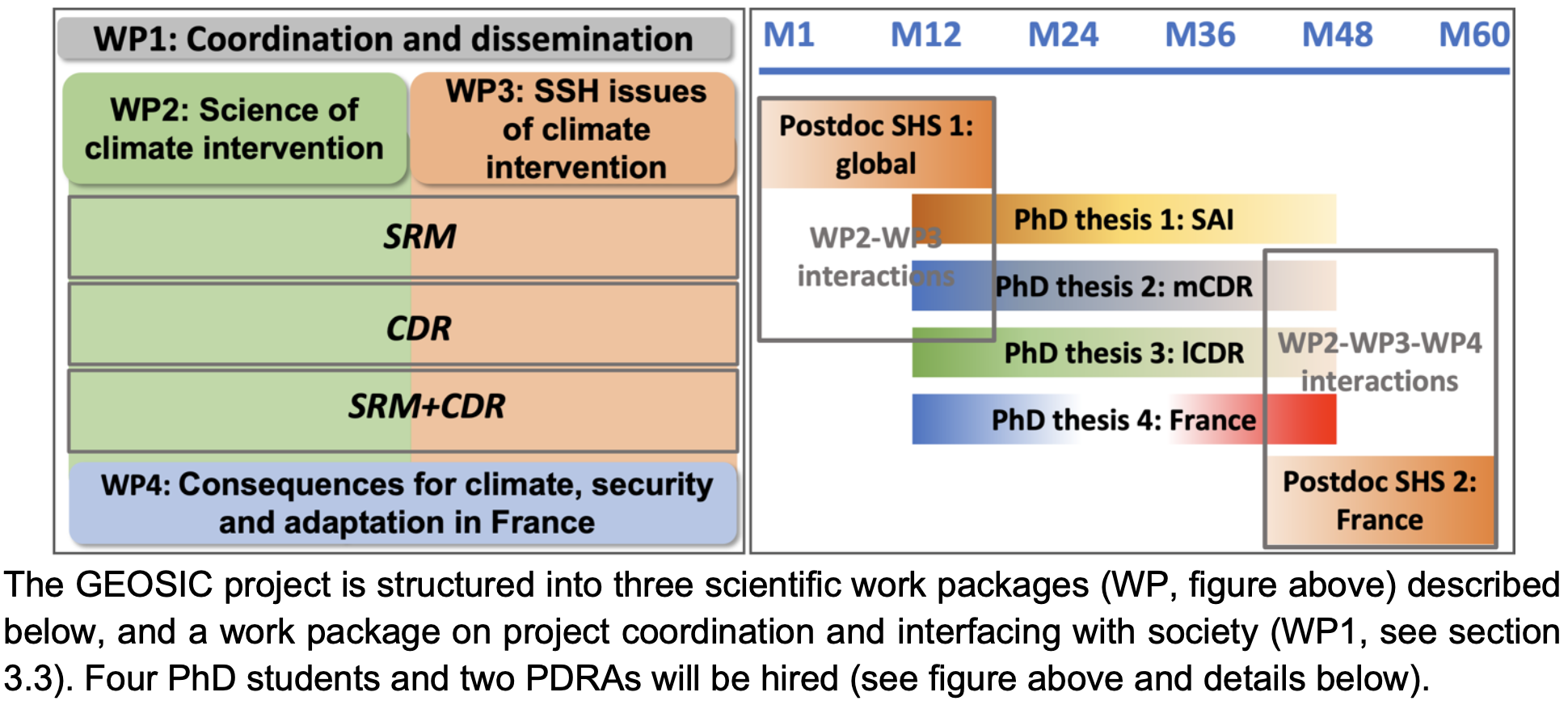
In a world where the necessary transition is not occurring fast enough, technological solutions to the climate crisis are increasingly favoured by decision-makers, but widely debated within the scientific community. The majority of these solutions are based on climate intervention (CI) methods that are grouped into two broad categories. Techniques that remove and store atmospheric CO2 (CDR), and techniques to correct the radiative imbalance caused by the accumulation of greenhouse gases in the atmosphere by increasing the planet’s albedo (SRM).
Current research does not sufficiently quantify the risks and uncertainties of these methods individually, nor their combined effects. Emissions scenarios for limiting global warming to 2°C include CDR, while the controversies surrounding SRM exclude it from the framework of future scenarios. In addition, the (geo)political and social components that will ultimately define the deployment of these techniques has not included the latest physical science research conducted on these topics. In order to inform future decisions, we need to account for all possibilities.
The GEOSIC project will combine studies of climate intervention techniques, individually and by studying their interactions, with geopolitical scenarios that encompass the variety of proposals. GEOSIC will address topics including the Incorporation of geopolitical scenarios in CI model simulations, the detectability of SRM deployment and its possible teleconnections; CDR (including ocean-based approaches) efficiency in various scenarios and its feasibility, carbon stock vulnerability and related uncertainties; interactions between SRM and CDR to understand their combined potential and synergies/antagonisms. These physical science questions will be interfaced with geopolitical issues concerning possible deployment governance; the conflict-generating nature of SRM deployment in a climate securitization context and the anticipation and prevention of such conflicts; climate injustice and inequalities linked to the heterogeneous access and deployment capacities of CI techniques; and their socio-environmental sustainability. Cross-disciplinary actions combining these questions complete this interdisciplinary project, producing a comprehensive vision of the CI landscape. Finally, to better predict the regional impacts of climate change and support necessary adaptation measures, a unique outcome of this project will be to focus on a future France in a new climate state. This includes France’s CDR needs to attain the national low-carbon trajectory and how SRM deployment would impact this. The results of the mentioned interdisciplinary studies will be re- examined at national level, providing an evaluation of the impacts and adaptation to climate change in the various scenarios.